
The 7 deadly sins of enterprise AI
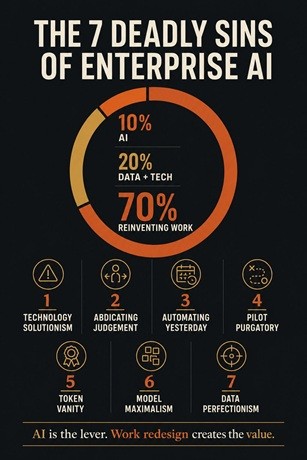
Most AI programmes don’t fail because the model isn’t clever enough. They fail because we use new technology to preserve old ways of working.
Here are the seven sins I see:
1️⃣ TECHNOLOGY SOLUTIONISM
Treating AI as the answer.
My working rule is 10–20–70: 10% AI. 20% data and technology.
70% reinventing how the organisation works.
AI is the lever. Work redesign creates the value.
2️⃣ ABDICATING JUDGEMENT
Removing people and accountability from the loop. AI can produce a persuasive answer without producing the right answer.
The essential skills are asking why, what, when—and who remains accountable.
3️⃣ AUTOMATING YESTERDAY’S PROCESS
Deploying agents to execute the existing workflow faster.
Automating a poor process simply scales the problem. Start with the decisions. Then determine how humans and machines should combine to produce the next best action.
4️⃣ PILOT PURGATORY
Launching disconnected use cases because they are easy to demonstrate.
A faster horse is still a horse. Start with the business outcome, map the decisions required to achieve it, and test the assumptions that carry the greatest risk.
5️⃣ TOKEN VANITY
Using token consumption, or its reduction as a proxy for value.
Tokens are a cost, not an outcome. Optimise for the cost of reaching a reliable decision, completing an action or generating measurable value.
6️⃣ MODEL MAXIMALISM
Using the biggest frontier model for everything. Most work does not require the most powerful model available.
Use the smallest, fastest and cheapest model that can reliably meet the requirement, and escalate only when the task demands it.
7️⃣ DATA PERFECTIONISM
Waiting for immaculate data before beginning.
AI can often extract value from imperfect and unstructured information. But imperfect is not the same as untrustworthy. Data must be sufficiently complete, current and unbiased for the decision being made.
🎯 The common thread?
Stop asking: “How can we add AI to the way we work?”
Start asking: “If we designed this business today, with AI available, how would the work get done?”
Which of these sins do you see most often?

Eddie Short
View on LinkedIn